Leo and the Clock Tower Mouse
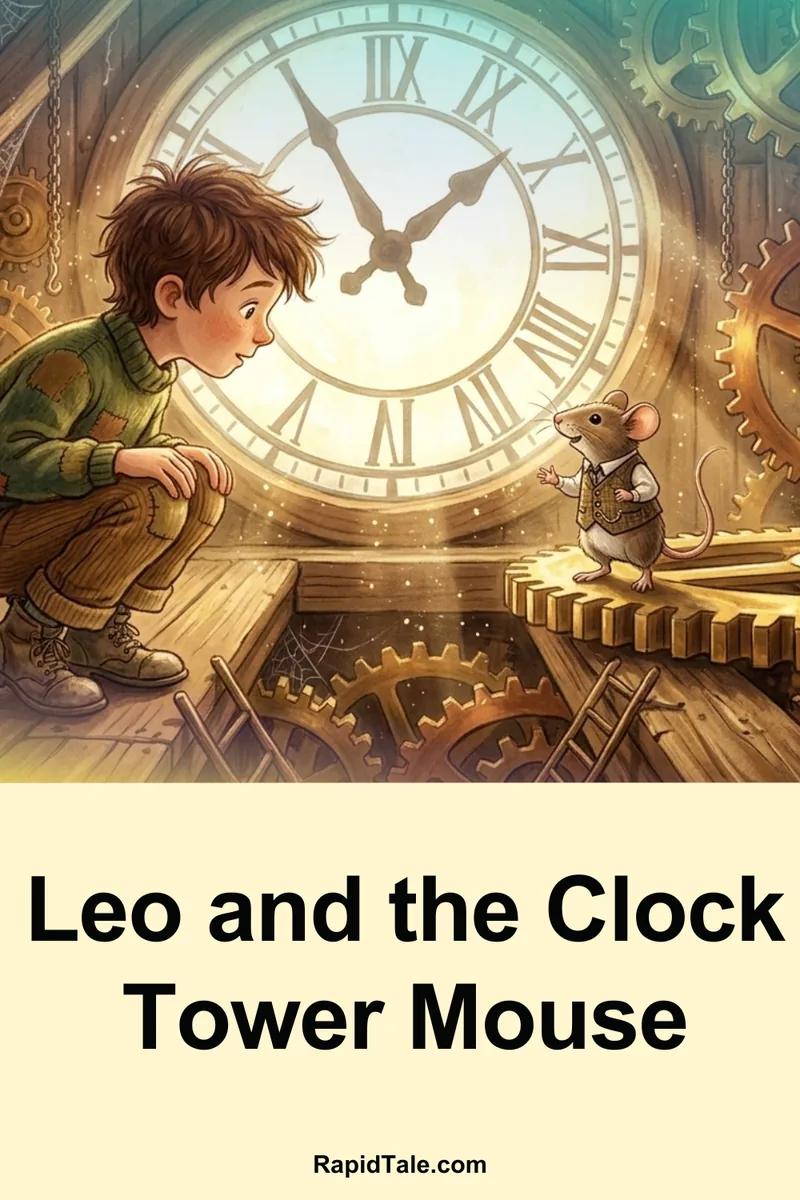
Leo Hartwell of Marlowe Bay can map any place he has been and cannot arrive anywhere on time, a flaw his mother and his own birthday party know well.
The Morning of the Harvest Fair
In the seaside village of Marlowe Bay, where the gulls squabbled over breakfast and the fishing boats bobbed in the harbor like sleepy ducks, there lived a boy named Leo Hartwell. Leo was nine years old. He had a crooked grin, a cowlick that refused to lie flat, and a head full of wonderful ideas. He could build a boat out of bottle corks. He could whistle like a blackbird. He could draw a map of any place he had ever been, down to the last pebble. But there was one thing Leo could not do, and that was be on time. He was late for breakfast. He was late for school. He was late for feeding the hens, late for the bus to the market, and late for his own birthday party, which was embarrassing, because everyone else had arrived and was hiding behind the sofa waiting to shout surprise. "Leo!" his mother would call up the stairs every morning. "You'll miss the bell!" "Coming!" Leo would shout back, and then he would sit down on the floor to finish one more drawing, and then another, and then he would look at the clock and gasp, "Oh no!" and tumble out the door with one shoe on and one shoe in his hand. "What's the harm?" he would say with a shrug. "A few minutes here and there. It's not as though anyone is hurt by it." But Leo did not yet know something important. When you are late, someone is always waiting. And waiting is a heavy thing to carry.
On Saturday morning, Leo had arranged to meet his best friend Sana at the harbor wall. "Ten o'clock sharp," Sana had said. "We're going to launch the kite we made. And the wind is perfect, so don't be late!" "I won't," said Leo, and he truly meant it. But on Saturday morning, he found a piece of driftwood on the way that looked exactly like a dragon, and he stopped to draw it. Then he saw a crab scuttling across the sand and followed it to see where it was going. Then he found a shell, and another shell, and before long, the church bells were chiming eleven. "Oh no!" cried Leo. "The kite!" He raced to the harbor wall as fast as his legs would carry him. Sana was sitting on the bench with the kite across her knees, hugging herself against the cold. Her nose was pink. The wind, which had been perfect an hour ago, had died down to almost nothing. "I'm sorry," panted Leo. "I found a driftwood dragon, and then a crab, and then..." "I waited an hour," said Sana quietly. "I thought maybe you'd forgotten. Or that something bad had happened. I almost went home." "But I'm here now!" said Leo brightly. "Let's fly it!" They tried. But the wind had gone, and the kite only flopped and wobbled and sank into the sand. Sana did not say anything cross. She simply picked it up, folded it carefully, and said, "Maybe next time." That was worse than if she had shouted. Leo walked home with his hands in his pockets and a strange, heavy feeling in his stomach, like he had swallowed a cold stone.
That evening, Leo could not sleep. He kept seeing Sana's pink nose and her folded kite. So he crept out of bed, pulled on his coat, and slipped out of the house to walk along the cobbled lane. At the top of the lane stood the old Clock Tower of Marlowe Bay. It was tall and gray and covered in ivy, and its great round clock face glowed gently in the moonlight. For two hundred years, its bell had rung the hours for the village. The fishermen set their nets by it. The baker rose to it. The children walked to school by it. Leo stood at the foot of the tower and sighed. "It must be nice," he said to no one, "to never be late." "It has its moments," said a tiny voice. Leo jumped. He looked up, down, and all around. Then, on the stone step at his feet, he spotted a very small mouse in a very small waistcoat. The mouse had round spectacles perched on his nose, a tiny silver watch on a chain, and an air of great importance. "You can talk!" said Leo. "Naturally," said the mouse. "I am Tick, Keeper of the Clock Tower. I have wound that clock every day for forty-two years, and in all that time, I have never once been late." He peered at Leo over his spectacles. "And you, if I am not mistaken, are the boy who is late for everything." Leo's ears went red. "How did you know?" "I sit at the top of the tallest tower in the village," said Tick. "I see a great deal. I have seen you running down the lane every morning, one shoe on and one shoe off." He folded his paws. "And I saw your friend on the harbor bench today." Leo's throat felt tight. "I didn't mean to," he whispered. "I never mean to be late. It just happens." Tick nodded thoughtfully. "Ah. I thought as much. Lateness is rarely about meaning to. It's about not noticing." He tapped the side of his nose. "Come up to the tower, Leo. I have something to show you."
The spiral staircase inside the tower was long and narrow, and it creaked at every step. Tick scurried ahead, carrying a tiny lantern, and Leo climbed behind, counting the stairs until he lost count at one hundred and twelve. At the top was a round room filled with enormous brass wheels and gears, all turning and clicking and humming together. Pendulums swung. Chains rattled. Everything moved in perfect rhythm, tick, tock, tick, tock, like a giant heart beating inside the stone. "This," said Tick proudly, "is the Heart of Marlowe Bay. Do you see how every wheel fits into the next? If one gear turns even a moment too late, the next one falters, and the next, and soon the whole clock is out of step." Leo gazed up at the gears. "Just like people," he said slowly. "Just like people," agreed Tick. "When you are late, Leo, it isn't only you who is affected. You are one wheel in a very large clock. Your friend waits. Your teacher waits. Your mother waits with your breakfast going cold. Their day shifts a little, because yours did not turn on time." Leo sat down on an upturned bucket. "I never thought of it like that. I thought being late was just... my own business." "Time belongs to everyone," said Tick gently. "When you keep someone waiting, you are spending a little of their time without asking. And time, once spent, can never be returned." Leo looked at his shoes. "I want to be better," he said in a small voice. "But I don't know how. I always mean to leave on time. And then something shiny or interesting comes along, and I forget." Tick smiled. He reached into his waistcoat pocket and pulled out something small and round and golden, which glinted in the lantern light. It was a pocket watch, no bigger than a walnut, with a tiny crack across its glass. "This was my grandfather's," said Tick. "He was Keeper of this tower before me. It doesn't keep perfect time. It's a little slow, and the glass is chipped. But it has a very useful quality." He pressed it into Leo's palm. "It reminds you." "Reminds me of what?" "Of the people waiting for you," said Tick. "Take it, Leo. Try it for one week. And remember three little rules that my grandfather taught me." He held up one tiny finger. "One: Prepare tonight for tomorrow. Lay out your things before you sleep." A second finger. "Two: Aim to be early. If you plan to arrive exactly on time, you will be late, because the world always has a small surprise waiting." A third. "Three: When something interesting tempts you on the way, remember that it will still be there tomorrow. The people waiting for you will not." Leo closed his fingers around the little watch. It felt warm, and he thought he could feel it ticking against his palm like a second heartbeat. "I'll try," he said. "That," said Tick, "is all anyone can ask."
The first morning was hard. Leo woke up, stretched, and reached for his drawing pad. But then he felt the watch ticking in his pocket, and he thought of Sana on the bench. He put the pad down. He washed, dressed, ate his porridge, and set off for school with ten whole minutes to spare. He arrived so early that the schoolyard was empty. The only person there was the caretaker, Mr. Okonkwo, who dropped his broom in surprise. "Leo Hartwell?" he said. "Is the world ending?" "No," said Leo, grinning. "I'm just early." The second morning was easier, because the night before, Leo had laid out his clothes, packed his school bag, and put both shoes side by side at the door. The third morning was easier still. By the fourth day, something strange had begun to happen. Leo noticed things he had never noticed before. The way the baker's windows steamed up at dawn. The way the harbor shimmered pink as the sun rose. The way his mother hummed while she made breakfast, because she no longer had to call up the stairs three times. He had time. That was the surprise. By not rushing, he had more time, not less. Time to look. Time to breathe. Time to stop for a moment and draw that driftwood dragon on the way, without feeling the sick, scrambled worry of knowing he ought to be somewhere else. On the fifth day, he knocked on Sana's door. She opened it, still in her slippers. "You're early," she said, blinking. "I know," said Leo. He held out his hand. In it was a folded piece of paper. "I made you something. It's a map of the best kite-flying spot in Marlowe Bay. And if you're free on Saturday, I'll be at the harbor wall at nine o'clock. Not ten. Nine. And I'll stay there until you come." Sana looked at the map. Then she looked at Leo. Slowly, she smiled. "All right," she said. "But if you're late, I'm flying it without you." "Fair," said Leo.
The biggest day of the year in Marlowe Bay was the Harvest Fair. Every year, the whole village gathered at the harbor for music and dancing and a great feast of fish and bread and apple cake. And every year, the fishing fleet sailed out at noon to bring in the last catch of the season. But there was a danger. Just beyond the harbor lay a long bank of sand called the Whisper Bar, and it was safe to cross only when the tide was high. Miss it, and the boats would run aground and be stuck for hours, and the fishermen would have to wait in the cold until the water returned. The signal for crossing was the Clock Tower bell, which rang at exactly noon. And this year, Tick the mouse had an announcement. Leo was in the village square, helping Sana hang paper lanterns, when a very small voice piped up from his coat pocket. "Leo," whispered Tick, peeking out. "I need your help. My old paws are stiff this morning. I have been up all night winding the clock, and I fear I cannot climb the last hundred steps in time to ring the noon bell." Leo stared at him. "You want me to ring it?" "I do," said Tick. "The tide will not wait, and neither will the fishermen. At noon exactly, the bell must ring. Not a minute after. Can you do it?" Leo's stomach flipped over. Only a week ago, he would have laughed and said, "I'll try!" and then wandered off to chase a butterfly. But he thought of Sana on the bench. He thought of the fishermen waiting in the cold. He took the little cracked watch from his pocket and held it tight. "I can do it," he said, and this time he meant it all the way down to his toes.
📖 Start reading Leo and the Clock Tower Mouse free
Quick answers about Leo and the Clock Tower Mouse
What is Leo and the Clock Tower Mouse about?
Leo Hartwell of Marlowe Bay can map any place he has been and cannot arrive anywhere on time, a flaw his mother and his own birthday party know well.
Is Leo and the Clock Tower Mouse free to read?
Yes. Every story on RapidTale is free to read in the browser, with no sign-up and nothing to install.
How long does it take to read?
This story runs 1 chapter — most readers finish in one sitting, and you can stop and return to any chapter using the contents list.
Who wrote it?
Nimra Khan — original fiction published on RapidTale.