Mira and the Seed of Kindness
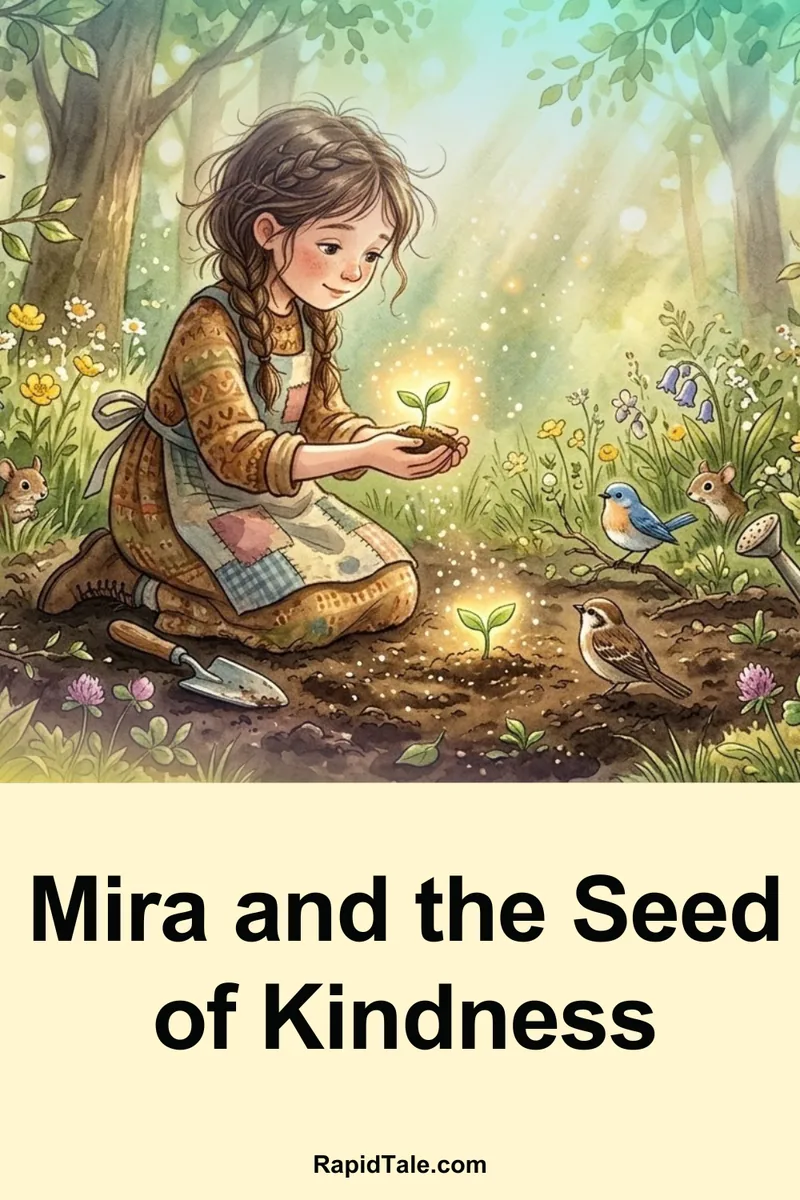
On a frosty walk to school Mira finds a pea-sized seed glowing gold in the snow, and a talking sparrow named Tuck says it is a Kindness Seed long waiting.
Soup and Silence
In a village called Thistledown, where the chimneys puffed like sleepy dragons and the snow lay thick on every roof, there lived a girl named Mira Fennimore. Mira was nine years old. She had two long braids, a red woolen hat with a pom-pom that bounced when she walked, and a heart that was a little bit shy and a little bit brave, depending on the day. One frosty morning, on her way to school, Mira noticed something shining in the snow beside the path. She crouched down and brushed away the white powder. There, resting in a tiny hollow, was a seed. It was no bigger than a pea, and it glowed with a soft golden light, like a candle seen through a frosted window. "Oh!" whispered Mira. "What are you?" "That," said a small voice, "is a Kindness Seed. And you really ought to pick it up before someone steps on it." Mira looked around. Sitting on the fence post was a plump brown sparrow with a fluffed-up chest and a very serious expression. "You can talk," said Mira. "Of course I can," said the sparrow. "My name is Tuck. I look after the Kindness Seeds. This one has been waiting a very long time for someone to find it, and it seems to have chosen you." Mira carefully cupped the seed in her mittened hands. It was warm, like a tiny heartbeat. "What does it do?" Tuck hopped closer. "It grows," he said. "But not with water, and not with sunshine. A Kindness Seed grows only when kindness is done. Every time you help someone, or share something, or say something gentle to someone who needs it, a new leaf will unfurl. Do enough kind things, and one day, it will bloom into something wonderful." "What will it become?" asked Mira. "Ah," said Tuck, tilting his head. "That depends on the one who plants it. But I'll tell you one secret, and you must remember it." He lowered his voice. "The seed knows the difference between kindness that comes from the heart and kindness that comes from wanting something in return. Keep that in mind." Then he fluttered up into the gray sky and was gone. Mira planted the seed that afternoon in an old clay pot and set it on her windowsill. It did not look like much. Just a little brown seed in a little brown pot. "Well," she said to it, "let's see what we can do."
The next morning, Mira was walking to school when she saw a new boy standing alone at the edge of the playground. His name was Oskar. He had moved to Thistledown only a week before, and he did not know anyone. He stood with his hands in his pockets, watching the other children play tag, and he looked like a boat that had drifted far away from the harbor. Mira felt her shyness tugging at her sleeve. Maybe someone else will go over, she thought. But then she remembered the little brown seed on her windowsill. She took a deep breath, walked across the snow, and held out half of her cinnamon bun. "Do you want some?" she asked. "My mother makes them. They're the best in Thistledown." Oskar looked at the bun. Then he looked at Mira. Slowly, he smiled. "Thank you," he said. "I'm Oskar." "I'm Mira. Come on, we're playing tag. You can be on my team." That afternoon, when Mira got home, she ran to her window. There, poking up from the soil, was a single green leaf, no bigger than a thumbnail. "It worked!" she gasped. The leaf trembled in the sunlight as if it were laughing.
After that, Mira could not stop thinking about the seed. Every morning, she raced to her window to see whether it had grown. And so, every day, she looked for ways to be kind. She carried Mr. Bellamy's firewood to his doorstep. She picked up a lost mitten and returned it to little Pia Lindqvist. She drew a get-well card for her classmate Jonas, who had the sniffles. She fed the birds, swept the church steps, and helped her neighbor hang out her laundry in the freezing air. And each time, the seed sprouted a new leaf. By the end of the second week, the little plant had seven. But something had begun to change inside Mira, and she had not noticed it yet. On a gray Tuesday, she helped Mrs. Alvarado, the shopkeeper, stack a pile of heavy boxes. As she worked, she was not thinking about Mrs. Alvarado at all. She was thinking, That should be at least two leaves. Maybe three. Maybe this will make it bloom early. When she got home, she rushed to the window. The plant had not grown a single leaf. Worse, two of its leaves had turned pale and droopy, like the ears of a sad rabbit. "What's wrong?" cried Mira. "I did something kind! I did lots of kind things!" There was a flutter at the glass. Tuck the sparrow was perched on the sill, looking at her with his bright black eyes. "Ah," he said gently. "I wondered when this would happen." "What did I do wrong?" asked Mira, her voice wobbling. "Tell me," said Tuck. "Why did you help Mrs. Alvarado today?" Mira opened her mouth to answer, and then she stopped. Her cheeks went warm. "I... I wanted the plant to grow," she admitted quietly. Tuck nodded. "That is what I told you, little one. The seed can tell. Kindness that is done to get something, even something nice like a leaf, is more like a trade than a gift. And a trade cannot make a Kindness Seed grow." Mira sank down on her bed. "So all my good deeds don't count?" "Oh, they counted," said Tuck warmly. "Mr. Bellamy still has warm firewood. Pia still has her mitten. Those kindnesses were real, and they mattered. But the seed grows best when you give for the joy of giving, not for the reward." Mira looked at the droopy plant and felt a lump in her throat. "How do I fix it?" "You don't fix it," said Tuck. "You simply begin again. And this time, forget about the seed. Think only about the person in front of you." Then he tipped his little head and flew away.
At the very end of Thistledown Lane, behind a crooked iron gate, stood a small gray house with a sagging roof. In it lived Mrs. Harrow. Mrs. Harrow was old, and she was grumpy. At least, that is what everyone in the village said. She never waved. She never smiled. If a ball bounced into her garden, she would snatch it up and keep it. The children called her "the Frowning Lady" and dared each other to touch her gate. Mira had never thought much about Mrs. Harrow. But the morning after her talk with Tuck, a heavy snowstorm blew through the village, and as she walked down the lane, she noticed something that made her stop. The snow had drifted high against Mrs. Harrow's front door. Every other house on the lane had a neat, shoveled path. But Mrs. Harrow's was buried, and there was no smoke coming from her chimney. Maybe she can't get out, Mira thought. Maybe she's cold. She did not think about the seed. She did not think about leaves. She simply fetched her father's big shovel from the shed, marched down the lane, and began to dig. It was hard work. The snow was heavy, and the shovel was almost as tall as she was. Her arms ached, and her nose turned red. But she kept digging until there was a clear, tidy path from the gate to the front door. Then, because she did not know what else to do, she knocked. No one answered. Mira waited. She was about to leave when the door creaked open, just a crack, and one sharp gray eye peered out. "What do you want?" said a crackly voice. "Nothing," said Mira. "Your door was stuck in the snow, so I shoveled it. I hope that's okay." The eye blinked. For a long moment, Mrs. Harrow said nothing at all. "Hmph," she said at last, and the door closed. Mira walked home with a funny feeling in her chest. She had not expected a thank-you, and she had not gotten one. But strangely, she did not mind. The feeling in her chest was warm and light, like having swallowed a little piece of sunshine. When she looked at the plant that evening, a brand-new leaf had unfurled. It was larger than the others, and it was glowing.
The next day, Mira went back. And the day after that. She did not make a fuss. She shoveled the path again when more snow fell. She left a bundle of kindling by the door. On the third day, she brought a jar of her mother's vegetable soup, still warm, and set it on the step with a little note: In case you're hungry. From Mira. She never knocked after the first time. She did not want to bother Mrs. Harrow. She only wanted her to be warm. On the fifth day, when Mira came by, the jar was waiting on the step. It was empty and had been scrubbed clean. Tucked inside was a folded scrap of paper. Mira unfolded it and read, in shaky, old-fashioned handwriting: Too much salt. But thank you. Mira laughed out loud. She ran all the way home and told her mother, who laughed too, and said, "Well, next time I'll use less salt." So the soup came again, with less salt, and the jar came back again, and each time there was a little note. Better. Then, Very good. Then, one day, My husband used to make soup like this. That was the day Mira knocked on the door again. This time, it opened wide. Mrs. Harrow stood there in a faded blue cardigan, leaning on a cane. Up close, she did not look grumpy at all. She looked tired, and a little bit shy, and very, very lonely. "Would you like to come in?" she asked. "I have tea. And I think I have some biscuits. If you don't mind them being a bit stale." "I don't mind at all," said Mira. Inside, the little house was full of faded photographs and quiet clocks. Mrs. Harrow poured the tea with trembling hands and told Mira about her husband, Edmund, who had been a clockmaker, and who had passed away three winters ago. She told her about her two grown children, who lived far away and wrote only at holidays. She told her about the garden she used to tend, which she was now too stiff to dig. "I'm not really grumpy, you know," Mrs. Harrow said, with a small, crooked smile. "I just got used to the quiet. And then it was easier to stay quiet than to try. When you've been alone a long time, it's hard to remember how to be around people." Mira thought about Oskar standing at the edge of the playground, and she understood. "You don't have to stay alone," she said. "I could visit. And my mother could come, and Mr. Bellamy, and the others. They don't know you, that's all. They think you don't want company." Mrs. Harrow's eyes grew shiny. "Do you think they would?" "I think," said Mira, "that you'll be surprised."
Mira was right. When she told her mother about Mrs. Harrow, her mother put down her spoon and said quietly, "Oh, that poor woman. We should have visited long ago." The very next Sunday, Mira's family walked down the lane with a basket of fresh bread. Mr. Bellamy came, too, carrying a bundle of split logs. Mrs. Alvarado brought a jar of plum jam. Oskar brought a drawing of Mrs. Harrow's house, with a big yellow sun above it, and little Pia Lindqvist brought her wobbly-eared stuffed rabbit, just in case Mrs. Harrow was lonely for a friend. Mrs. Harrow opened the door and found her whole lane standing on her step. She did not say a word. She simply pressed her hands to her mouth, and her eyes filled up, and she laughed and cried at the same time. "Well," she said, when she could speak. "You had all better come in. I only have six chairs." They squeezed in anyway. They sat on the chairs and the floor and the arms of the sofa, drinking tea out of mismatched cups, and the little house, which had been quiet for three long winters, rang with talk and laughter. Mr. Bellamy fixed the loose hinge on the garden gate. Mrs. Alvarado found a drawer full of Edmund's old clock parts and said they ought to be in a museum. Oskar asked a hundred questions about how clocks worked, and Mrs. Harrow answered every single one. And Mira sat on a footstool in the corner, with a stale biscuit in her hand, feeling happier than she had ever felt in her life. She did not think about the seed once.
📖 Start reading Mira and the Seed of Kindness free
Quick answers about Mira and the Seed of Kindness
What is Mira and the Seed of Kindness about?
On a frosty walk to school Mira finds a pea-sized seed glowing gold in the snow, and a talking sparrow named Tuck says it is a Kindness Seed long waiting.
Is Mira and the Seed of Kindness free to read?
Yes. Every story on RapidTale is free to read in the browser, with no sign-up and nothing to install.
How long does it take to read?
This story runs 1 chapter — most readers finish in one sitting, and you can stop and return to any chapter using the contents list.
Who wrote it?
Nimra Khan — original fiction published on RapidTale.