Toby and the Weight Stone
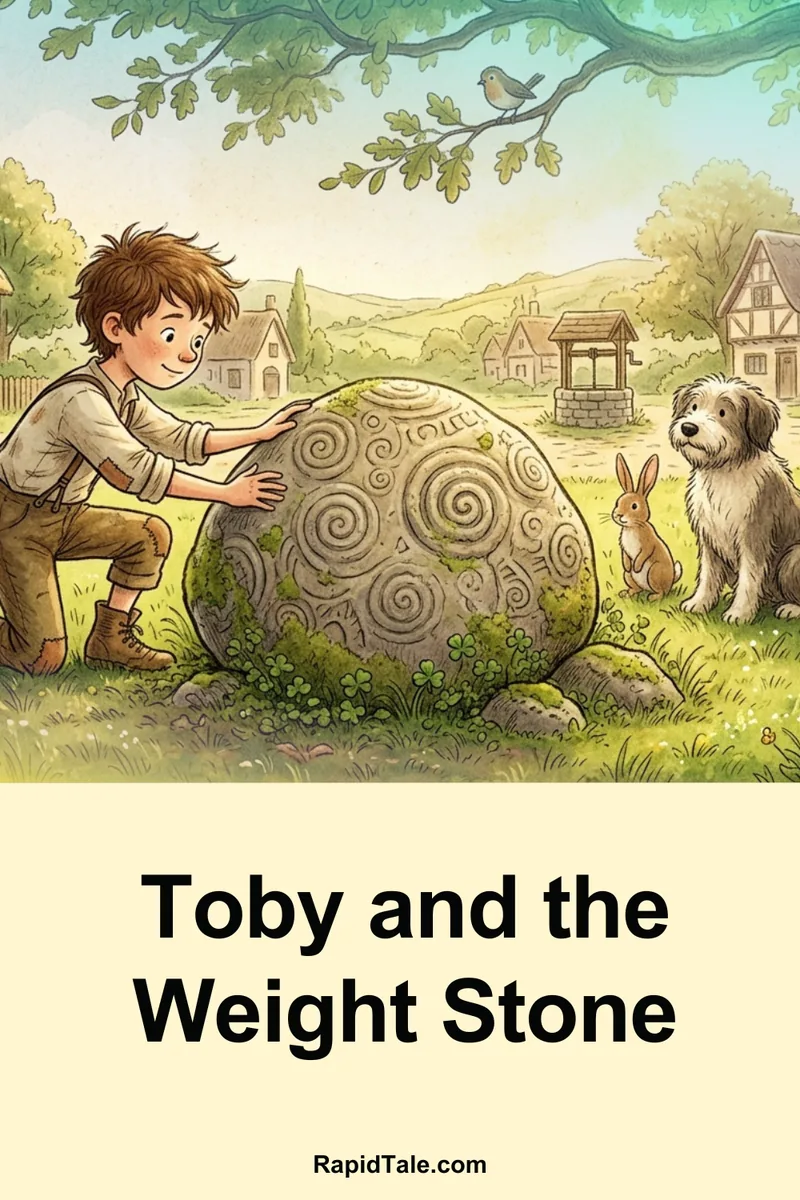
Toby is a good boy with one trouble: when he is frightened the truth sticks in his throat, and the worst place for that is Mrs Calloway's orchid greenhouse.
Three Small Words
In the village of Pebblebrook, where a clear little stream tumbled over round gray stones and every garden smelled of lavender, there lived a boy named Toby Wren. Toby was nine years old. He had freckles across his nose, grass stains on both knees, and a bright red ball that he took everywhere he went. He kicked it to school. He kicked it to the shop. He kicked it up the lane and down the lane and, on rainy days, around and around the kitchen table, until his mother sighed and sent him outside. Toby was a good boy. He shared his sweets, helped his little sister tie her shoes, and always said please and thank you. But Toby also had one small, secret trouble. When he was frightened, the truth seemed to get stuck in his throat, like a fishbone. At the end of Toby's lane stood the house of Mrs. Calloway, a kind old woman with silver hair and a bright yellow raincoat. Behind her house was her pride and joy: a glass greenhouse, shining like a giant jewel in the sun. Inside it grew hundreds of orchids in every color, and the finest of them all was the Moonlight Orchid, which had taken Mrs. Calloway eleven years to grow. It was to be shown at the Pebblebrook Flower Show on Saturday. "Stay away from my greenhouse with that ball, young Toby," Mrs. Calloway would say, wagging a friendly finger. "Glass is a fragile thing." "Yes, Mrs. Calloway," Toby would reply. And he always meant it. Until the day he forgot.
It was a golden Wednesday afternoon, and Toby was practicing his best kick. He had been trying all week to curl the ball around the old oak tree, just like the footballers on television. "One more try," he muttered. He took three steps back, ran forward, and swung his leg with all his might. The ball soared high in the air, curled beautifully around the oak, and kept going. It sailed over the hedge, over the fence, and straight toward the shining glass roof of Mrs. Calloway's greenhouse. CRASH! The sound of breaking glass rang out like a hundred tiny bells. Toby's heart stopped. He ran to the hedge and peeked through. A great jagged hole gaped in the glass, and beneath it, on the greenhouse floor, lay the red ball. Next to it, knocked from its shelf, lay a smashed clay pot and a crushed, pale petal. The Moonlight Orchid. Toby's stomach turned to ice. "Oh no," he whispered. "Oh no, oh no, oh no." From the cottage came the sound of a door opening. Footsteps crunched on the path. Toby panicked. He did not stop to think. He turned and ran, as fast as his legs would carry him, all the way home. He raced up the stairs, dove under his blanket, and lay there with his heart pounding like a drum. I'll just say nothing, he thought. No one saw me. No one will ever know. But the truth, once it has been left behind, does not simply disappear. It waits, quietly, like a shadow.
The next morning, Toby woke up with a tight, queasy feeling in his tummy. He did not want any breakfast. When his mother asked what was wrong, he said, "Nothing," and that was his first little lie. He walked to school the long way, so he would not pass Mrs. Calloway's house. Down by the stream, he stopped on the stepping stones and stared at the rushing water. "You look like a boy carrying something heavy," said a voice. Toby jumped. Sitting on a flat rock beside the stream was a tall, thin woman with a gray shawl and a face as wrinkled as a walnut. She was knitting something very long and very green, and a gray heron stood beside her, perfectly still, as if it were listening. "I'm not carrying anything," said Toby. That was his second little lie. "Hmm," said the old woman. She put down her knitting and looked at him with eyes as clear as the stream. "My name is Granny Marsh. I have lived by this water a very long time, and I know a heavy heart when I see one. Would you like to hear a secret?" Toby shuffled his feet. "All right." Granny Marsh reached into her shawl and drew out a small, smooth, gray pebble. She held it out in her wrinkled palm. "This is a Weight Stone," she said. "It will keep you company. It is very small today. But it has a peculiar habit. Whenever you tell a lie, it grows a little heavier. And whenever you speak the truth, it grows a little lighter." Toby stared at the pebble. "That's silly," he said. "Stones don't do that." "No?" said Granny Marsh, her eyes twinkling. "Then you have nothing to worry about." She pressed it into his hand and closed his fingers around it. Toby meant to throw it into the stream. But somehow, he found himself slipping it into his pocket instead. When he looked up, the old woman and the heron were gone. Only the knitting remained, a long green scarf draped over the rock, swaying gently in the breeze.
At school that day, the whole village was buzzing. "Have you heard?" whispered Lila Hartley, Toby's best friend, as they hung up their coats. "Somebody smashed Mrs. Calloway's greenhouse last night! And the Moonlight Orchid is ruined!" Toby's throat went dry. "Really?" he said. "That's terrible." The stone in his pocket felt a little heavier. "Mrs. Calloway found muddy paw prints all over the garden," Lila went on, her eyes wide. "She thinks it was a dog. And everyone knows the only big dog on our lane is..." She stopped, and her face crumpled. "Biscuit." Biscuit was Lila's golden retriever. He was big and shaggy and clumsy, and he loved nothing in the world so much as chasing a ball. "But Biscuit would never," said Lila, her lip trembling. "Would he?" Toby knew exactly who had smashed the greenhouse, and it was not Biscuit. All he had to do was say the words. It was me. Three small words. But they stuck in his throat like a fishbone. "I don't know," he mumbled. "Maybe he did. Dogs do all sorts of things." The stone in his pocket grew so heavy that Toby felt it tugging at his trousers. That afternoon, Mrs. Calloway marched up the lane with a very stern face and spoke to Lila's father. Biscuit was to be kept tied up in the yard until the matter was settled. Lila cried all evening. And when Mr. Hartley asked Toby whether he had seen anything near the greenhouse on Wednesday, Toby said, in a very small voice, "No." That was another lie. And another. And another. Each one weighed more than the one before. By bedtime, the stone was as heavy as a loaf of bread. By the next morning, it was as heavy as a brick. Toby could barely walk. His pocket sagged to his knees. His shoulders slumped. He couldn't kick his ball, couldn't run, couldn't laugh at his sister's jokes. Even his dinner tasted like sawdust. Worst of all, whenever he looked out the window, he could see Biscuit lying miserably on the end of a rope, his big brown eyes drooping and his tail still. "I never wanted any of this," Toby whispered into his pillow. "I only wanted not to be in trouble." But the lie had grown bigger than he ever imagined, like a snowball rolling downhill.
On Friday afternoon, Toby dragged himself back to the stream. He had to use both hands to lift the stone out of his pocket, and he dropped it with a thud onto the bank. Granny Marsh was sitting on her rock, knitting, the heron beside her. She did not look surprised. "Take it back," said Toby, his voice cracking. "Please. It's too heavy. I can't carry it anymore." "Ah," said Granny Marsh gently. "I cannot take it back, little one. It was never mine to carry. It is yours." "But why does it get so heavy?" Granny Marsh set aside her knitting and patted the rock beside her. Toby sat down. "A lie is a funny thing," she said. "It seems small when you first tell it, as small as a pebble. But a lie cannot stand on its own two feet. It needs another lie to prop it up, and then another to prop up that one, until you are carrying a whole mountain of them. And all the while, you must remember each and every one, so you do not get caught." "It's exhausting," Toby admitted. "Yes," said Granny Marsh. "And it is not only you who carries the weight. Think of Biscuit, tied up in the yard. Think of Lila, crying into her pillow. Think of Mrs. Calloway, who believes a dog broke her heart. A lie is like a stone thrown in a pond. The ripples spread farther than you ever imagined." Toby's eyes stung. "I'm scared," he whispered. "Mrs. Calloway will be so angry. My parents will be so disappointed. Everyone will know what I did." "Perhaps they will," said Granny Marsh. "The truth is not always comfortable, little one. Sometimes it is as scary as stepping off a high bridge. But do you know what is on the other side of the truth?" "What?" "Lightness," said the old woman. "Freedom. A heart that sleeps well at night. And people who can trust your words, which is worth more than all the orchids in the world." The heron stirred, spread its great gray wings, and lifted gracefully into the air. Toby watched it rise, so light and easy, and he thought how wonderful it would feel to be that light. He wiped his nose on his sleeve. Then he picked up the stone, which seemed to weigh a little less just for having made up his mind, and stood. "Thank you, Granny Marsh," he said. "Go on, brave boy," she said. "The truth is waiting."
It was the longest walk of Toby's life. He walked up the lane, one heavy step at a time, until he reached Mrs. Calloway's gate. The greenhouse stood in the late sunlight, its broken roof glittering. Mrs. Calloway was kneeling by the shattered pot, gently sweeping up fragments of clay with a little brush. Her shoulders drooped. When she turned, Toby saw that her eyes were red. His knees nearly gave way. His heart hammered. For a moment, he thought of turning around and running. But he thought of Biscuit's drooping tail, and he took a deep breath. "Mrs. Calloway," he said. His voice came out small and shaky. "It was me." Mrs. Calloway looked up. "What was, dear?" "It was me who broke your greenhouse," said Toby. The words tumbled out faster now, like water breaking through a dam. "I was practicing my kick, and the ball went over the hedge, and I got scared and ran away. I didn't tell anyone. And then everyone thought it was Biscuit, and I let them think so, and I told lies about it. I told lots of lies. I'm so sorry. It wasn't Biscuit. It was never Biscuit. It was me." Tears rolled down his cheeks. He held out the stone in his shaking hands. "And I'll do anything to make it right." There was a very long silence. Then, something wonderful and strange happened. The Weight Stone in Toby's palm began to glow, softly, like a tiny moon. It grew lighter and lighter and lighter, until it weighed no more than a feather. Then it floated gently out of his hand, rose into the air, and dissolved into a puff of silver sparkles that drifted away on the breeze. Toby felt as if a great sack of bricks had been lifted off his back. He took a deep, deep breath, the first real one in days. Mrs. Calloway, who had seen none of the sparkles, set down her brush and stood up. Her face was serious. Toby braced himself. "Toby Wren," she said slowly. "I am very sad about my orchid. And I am very upset that Biscuit was blamed, and that lies were told." "I know," whispered Toby. "But," she continued, and her voice softened, "I am also proud of you. It takes a great deal of courage to tell the truth when you are frightened. Many grown-ups never learn how." She knelt in front of him and put her hands on his shoulders. "You made a mistake. Everyone does. But you did the hard, brave thing and set it right. That matters more to me than any flower." Toby burst into tears and threw his arms around her. She hugged him back, firmly and warmly.
📖 Start reading Toby and the Weight Stone free
Quick answers about Toby and the Weight Stone
What is Toby and the Weight Stone about?
Toby is a good boy with one trouble: when he is frightened the truth sticks in his throat, and the worst place for that is Mrs Calloway's orchid greenhouse.
Is Toby and the Weight Stone free to read?
Yes. Every story on RapidTale is free to read in the browser, with no sign-up and nothing to install.
How long does it take to read?
This story runs 1 chapter — most readers finish in one sitting, and you can stop and return to any chapter using the contents list.
Who wrote it?
Nimra Khan — original fiction published on RapidTale.